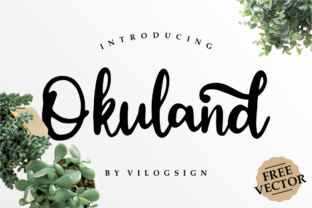
Okuland: A Whimsical Handwritten Font for Handmade Product Design
There is a moment in every maker’s studio when the design finally clicks. For me, that moment came while I was staring at a blank candle label template on my screen. The soy wax had already been poured and cured in little amber jars, the fragrance notes were set, and the packaging was waiting. But the label felt flat. The text I had chosen felt too rigid, too predictable for a candleshop built on warmth and nostalgia. That is when I opened Okuland, a handwritten font with an authentic, almost storybook charm. Suddenly the label read like a handwritten note from the maker herself. The shift was subtle, but the whole product came alive.
Okuland belongs to a category I often turn to when I need a typeface that feels personal rather than polished. It is a script font with a free-spirited, playful rhythm that mimics real hand lettering. The letters are not perfectly uniform. They carry slight irregularities, gentle slopes, and natural variations that make every word feel as if it were written with a fine pen on a cozy afternoon. That authenticity is hard to find in most digital fonts, and it is exactly what handmade product packaging needs.
What Makes Okuland Stand Out in a Craft Studio
When I first used Okuland for a set of product labels, I noticed how it softened the overall look. The font has a whimsical quality without being childish. It feels grown-up in its artistry but playful in its execution. The strokes are fluid, the curves are generous, and the overall mood is gentle and inviting. For a handmade seller, that emotional tone is gold. Customers do not just buy a candle or a card. They buy the feeling the product gives them. Okuland delivers that feeling before they even open the package.
The typeface works beautifully for short phrases, product names, and decorative headings. I have used it on candle labels reading “Warm Vanilla and Honey,” on kraft paper tags saying “Thank You,” and on greeting cards with messages like “You Are Loved.” Every time, the handwritten quality adds a layer of warmth that a standard serif or sans serif font simply cannot replicate. It looks like it belongs on handmade goods because it feels handmade itself.
Real Product Applications for Okuland
Over the past few months, I have incorporated Okuland into several product lines. Each application revealed something new about the font’s versatility.
- Candle and Wax Product Labels – The font reads clearly on small oval and rectangle labels when sized between 18 and 24 points. I pair it with a clean sans serif for scent notes and ingredients, letting Okuland carry the product name and any short sentiment. The contrast is clean and professional.
- Greeting Cards and Birthday Invitations – For a recent birthday card set, I used Okuland for the main greeting and a simple serif for the interior message. The handwritten style made the cards feel personal, as if each one had been addressed by hand. I received comments from customers saying the cards looked “so thoughtful.”
- Boutique Product Tags and Packaging – Small clothing and accessory tags benefit from the font’s readable letterforms. Even at smaller sizes, Okuland maintains its character. I use it on hang tags for linen aprons and reusable tote bags, always keeping the text short to preserve legibility.
- Printable Wall Art and Digital Downloads – For my printable art shop, Okuland appears in quote prints and nursery decor. The whimsical feel suits motivational phrases and nature-inspired sayings. I pair it with a simple sans serif for the attribution line, and the overall design feels cohesive and intentional.
- Wedding Welcome Boards and Signage – While testing the font for a wedding welcome sign mockup, I found it worked wonderfully for names, dates, and short phrases like “Welcome to Our Celebration.” The handwritten style added an intimate, informal elegance that bridal parties often seek for rustic or garden weddings.
- Sticker Sheets and Planner Decor – Okuland is an excellent choice for sticker designs, especially word stickers and short labels. I have designed sheets with words like “Dream,” “Create,” “Gratitude,” and “Breathe.” The font cuts well on my cutting machine when I use a slightly thicker stroke setting and test the cut on a small sample first.
How Okuland Affects Product Presentation and Brand Perception
Using Okuland consistently across my product line has given my shop a more unified visual identity. When customers see the same handwritten style on candle labels, thank you cards, and product tags, they begin to associate that look with my brand. That recognition builds trust. It also signals that care was taken in the design process. A font that looks authentic and well-chosen elevates the perceived quality of the product. A candle with a beautiful handwritten label feels more artisanal than one with a generic typeface. That difference matters when you are selling in a crowded marketplace.
The emotional appeal of Okuland is also worth noting. Handwritten fonts tend to evoke feelings of closeness, nostalgia, and sincerity. When a customer receives a package with a tag that looks hand-lettered, they feel a personal connection to the maker. That connection often leads to repeat purchases and word-of-mouth recommendations. In my own shop, I have noticed that products featuring Okuland in the listing images tend to receive more saves and favorites. I attribute that to the font’s approachable, human quality.
Practical Considerations for Cutting Machines and Printed Products
If you plan to use Okuland with a cutting machine, a few adjustments will help you get clean results. The font has natural thin and thick strokes typical of script typefaces. When cutting small text, I recommend using a test cut on a scrap piece of vinyl or adhesive paper. If the thin strokes are not cutting cleanly, try increasing the blade pressure slightly or using a font size above 20 points for intricate words. For larger designs like welcome signs or tote bag transfers, the font performs beautifully without extra adjustments.
On printed labels, cardstock, and sticker paper, Okuland reads clearly when the background is light or neutral. Dark backgrounds can work too, but I suggest using a light-colored or white fill for the text to maintain contrast. Test a sample print before committing to a full batch, especially if you are printing on textured paper where fine strokes may appear less crisp.
Font Pairing Suggestions for a Cohesive Look
Okuland shines brightest when it is paired with a simple, understated companion font. I have tested several combinations and found the following to work well in my projects.
- With a Clean Sans Serif – A minimalist sans serif like Montserrat or Open Sans balances the whimsy of Okuland and keeps the design grounded. Use the sans serif for body text, ingredient lists, or secondary information.
- With a Simple Serif – A classic serif font, such as Playfair Display or Lora, adds a touch of elegance when paired with Okuland for wedding invitations or formal packaging. The serif brings structure, while Okuland brings personality.
- With Another Handwritten Font – If you want a layered, sketchbook feel, pair Okuland with a simpler handwritten font that does not compete for attention. Use one for the main heading and the other for a short accent phrase.
- With a Bold Display Font – For poster designs or large signage, a bold sans serif or slab serif can anchor the layout while Okuland adds the soft, human touch. This pairing works well for shop signs and fair displays.
Licensing, File Formats, and What to Check Before You Sell
Before using Okuland in any commercial product, take a moment to review the licensing terms included with your purchase. The font is available from Script Amp as a premium font, and the license will specify whether you are allowed to use it on physical merchandise, digital downloads, printables, or templates for resale. Some licenses cover personal use only, while others extend to commercial projects. If you plan to sell products that feature the font, make sure you have the appropriate commercial license. This step protects your shop and respects the work of the type designer.
Check which file formats are included in your download. Typically you will receive OTF and TTF files, which work across design software and operating systems. If you use a cutting machine program like Cricut Design Space or Silhouette Studio, TTF files are usually the easiest to install. You may also want to confirm whether Okuland includes ligatures, alternate characters, or swashes. These extras add even more handmade variety to your designs and make each product feel unique. A font with multiple stylistic alternates allows you to customize words so they never look exactly the same twice.
If you plan to sell digital templates or printable wall art, be aware that some licenses restrict embedding the font in editable files. In those cases, you can flatten the text as an image or outline the type before sharing the file. Always read the license agreement carefully so you can design with confidence and avoid issues later.
Real Projects Where Okuland Made a Difference
I recently prepared a batch of holiday gift tags using Okuland. Each tag carried the name of a different seasonal scent, such as “Cinnamon Clove” and “Spiced Apple.” I printed them on recycled kraft paper and punched a hole for twine. The handwritten style made the tags feel like they had been written by hand in a cozy kitchen. Those tags sold quickly in my shop, and several buyers mentioned they kept the tags as bookmarks or decorations. That simple detail, a thoughtful font choice, turned a functional item into something customers wanted to keep.
Another project involved a set of nursery prints for a custom order. The customer wanted a quote about dreaming and growing. I set the main phrase in Okuland and used a clean sans serif for the credit line. The final prints felt warm and personal, exactly what the customer envisioned for a child’s room. The font’s gentle curves and natural flow made the quote feel like a loving note rather than a mass-produced print.
Okuland has also become my go-to font for mockup previews in my shop listings. When I create listing images that show a label on a jar or a card on a tabletop, using Okuland in the mockup helps customers picture the product in their own homes. The font’s approachable style invites them to imagine the product as part of their everyday life. That visual storytelling is powerful for handmade sellers.
Whether you are labeling handmade soaps, designing wedding invitations, creating sticker sheets, or building a cohesive brand for your small shop, Okuland offers a lovely, authentic voice. It brings a sense of warmth and personality that standard fonts cannot match. With thoughtful pairing, careful sizing, and attention to licensing, you can use this font to elevate your products and connect with your customers on a more personal level. In a world of mass production, a font that feels handwritten is a small but meaningful way to stand out.